Artificial Intelligence. Custom AI products and automation.
Custom AI software, machine learning and intelligent automation tailored to business workflows.

Why owners choose this.
What it can look like. Screens from systems like this.
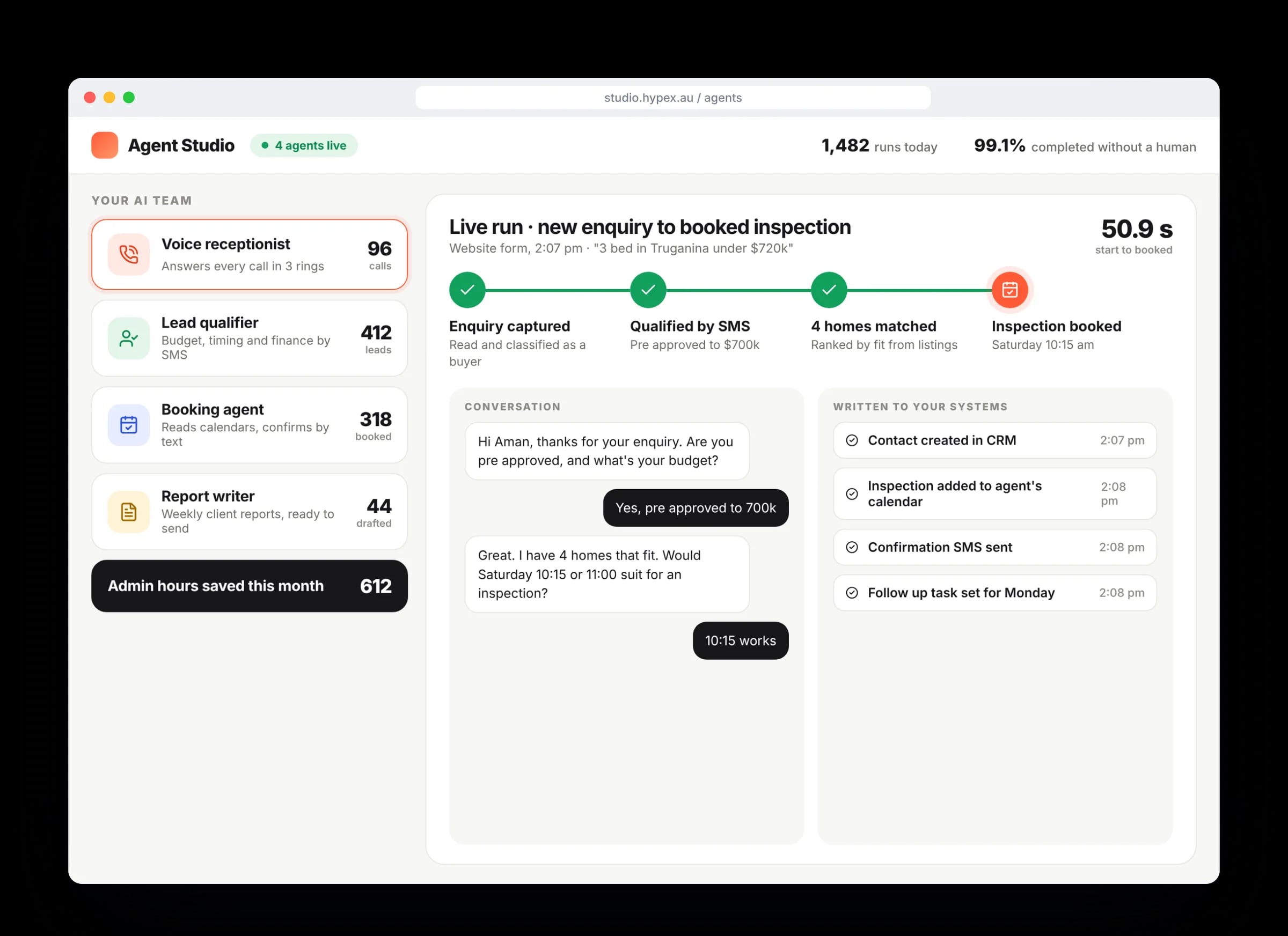
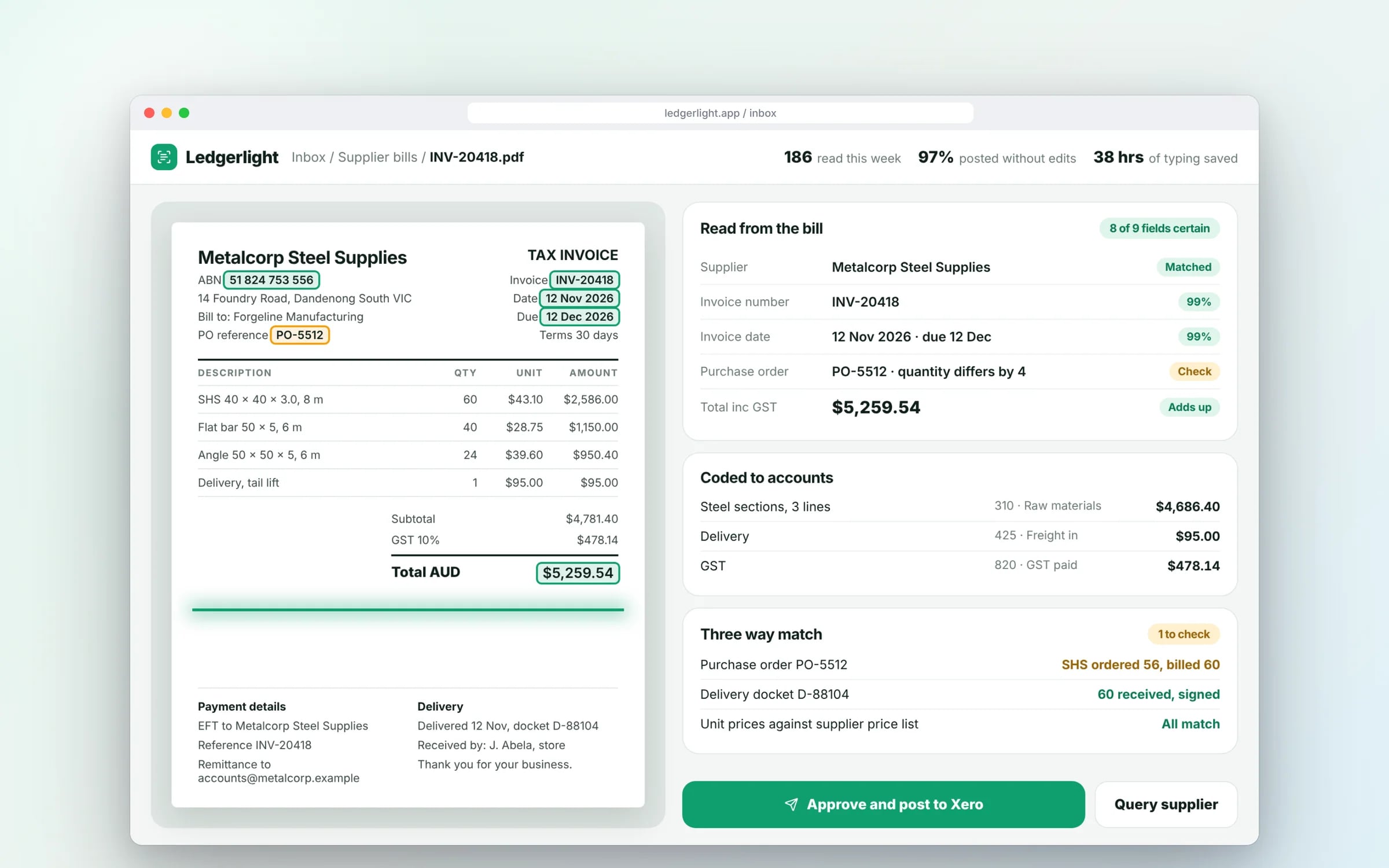
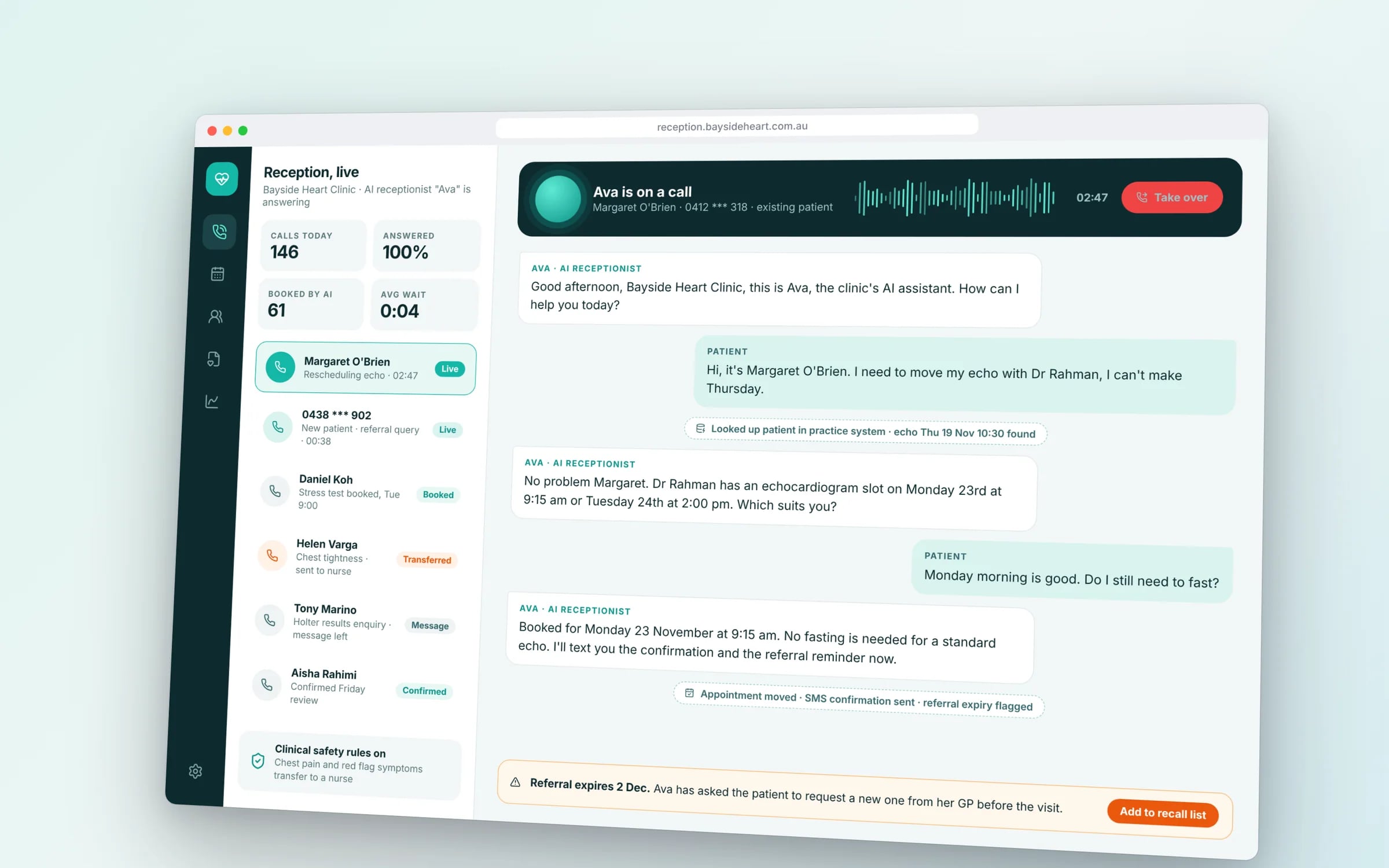
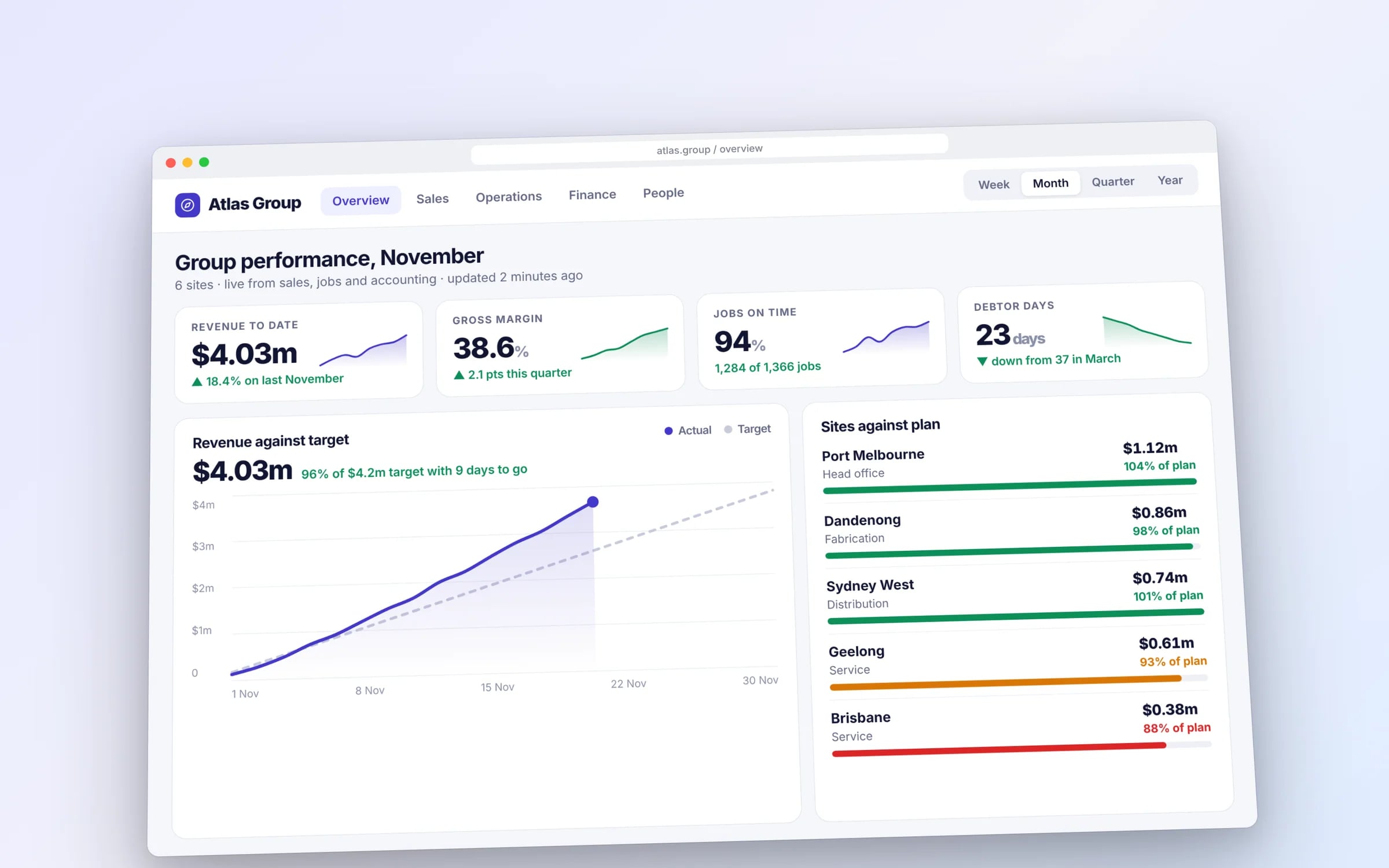
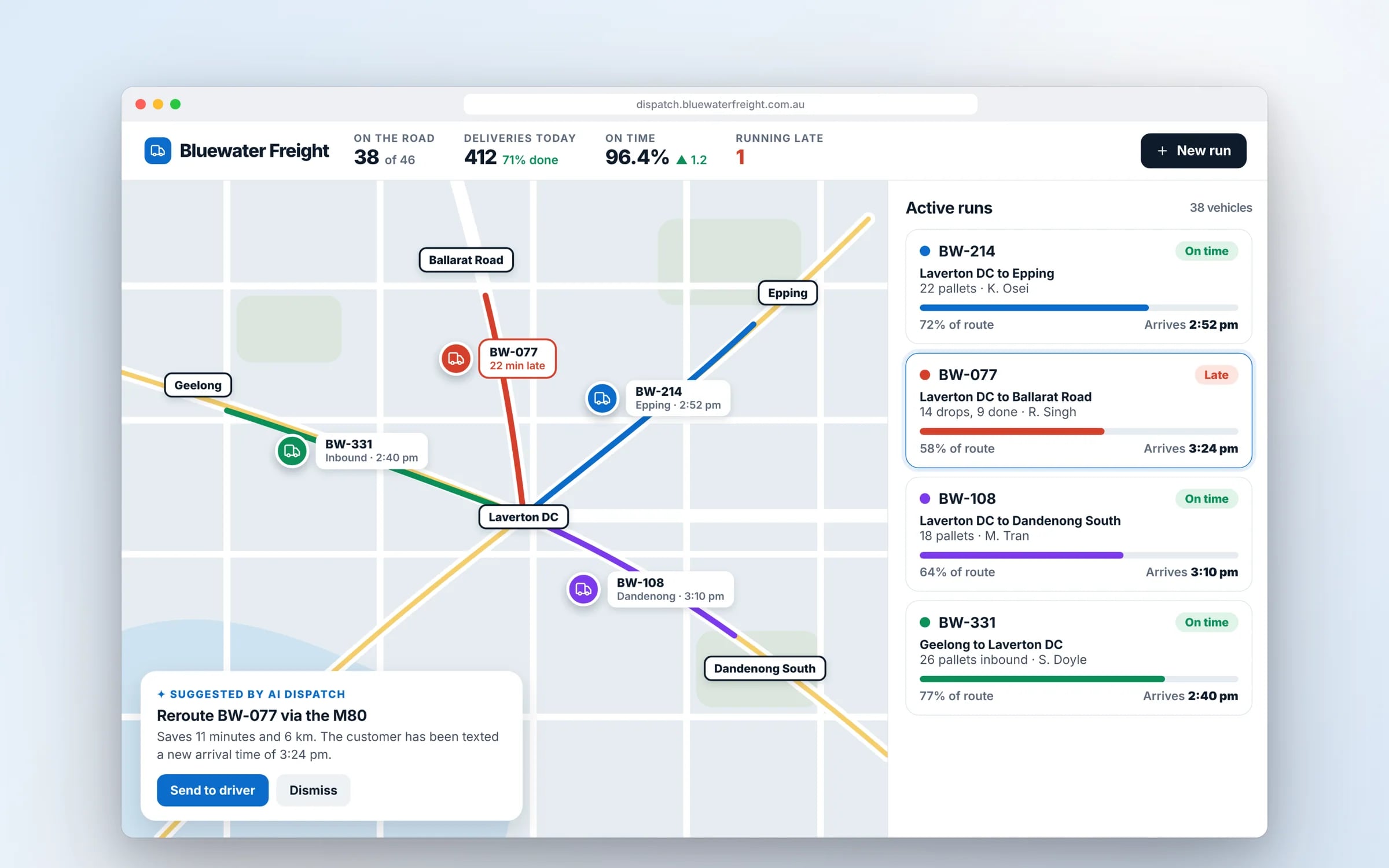
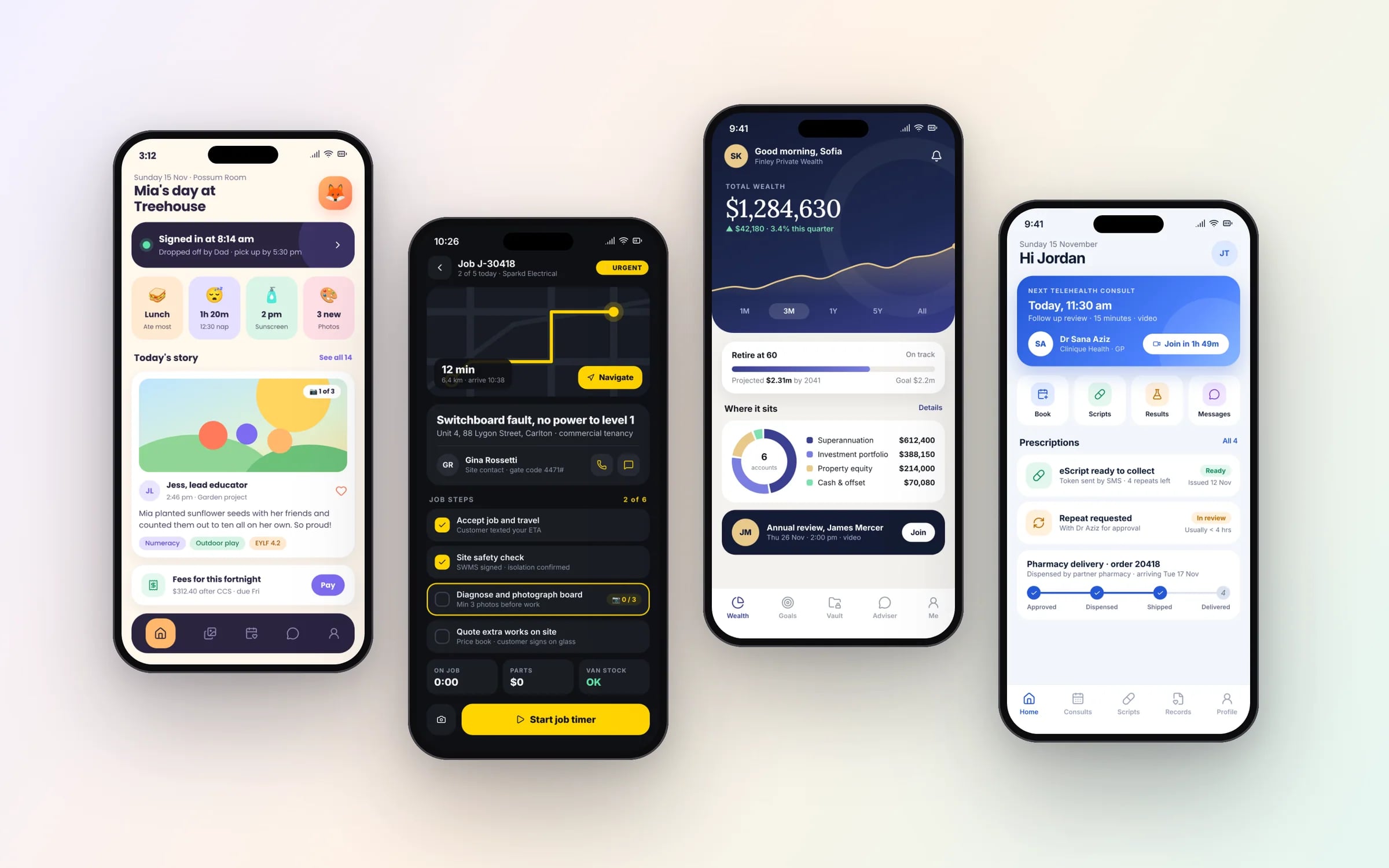
Example screens. The business names on them are invented.
You probably need this when
- 01Staff spend part of every day copying details from emails and PDFs into another system.
- 02Enquiries sit unread overnight or over the weekend because no one has got to them yet.
- 03You tried a generic AI tool, but it cannot see your jobs, customers or price list.
- 04Only one or two people know how to process certain orders or claims.
- 05You want AI in the business, but you need to know who approved what, and when.
One request, six systems. Each call scoped and logged.
An agent run reaches only the systems its job needs, one key each, and writes every call to a log you can read afterwards.
What you walk away with.
- 01AI strategy and architecture
- 02A production-ready AI product
- 03Monitoring and governance
How it runs, step by step.
- Step 1
Pick one job
On the discovery call we find the task with the most repetitive reading and retyping, and agree what a correct result looks like.
- Step 2
Map the data and permissions
The system map lists which records the agent reads, what it may change, which decisions wait for approval, and a fixed price for each stage.
- Step 3
Test on your real documents
We run the agent against past emails, invoices or orders from your business and check its results before it goes live.
- Step 4
Go live with a review queue
Your team approves the agent's work at first, approval steps are relaxed only where you choose, and every action is logged.
★★★★★
“It has led to more sales because of how professional it is!”
Where the admin hours go. And what an agent takes off them.
- Re-keying invoices and bills9 h/wk
- Chasing quotes and follow-ups7 h/wk
- Copying job notes between apps6 h/wk
- Building the weekly report4 h/wk
Illustrative: a typical week for an office team of five. An agent drafts or does each of these; a person approves.
What is Artificial Intelligence?
Custom AI for business is software that uses language and machine learning models to do a defined job inside your own systems, such as reading supplier invoices, turning emails into jobs, drafting quotes or flagging late orders.
It suits established businesses where staff spend hours reading and retyping, and where a person still approves the decisions that matter.
Reviewed by the Hypex team, Port Melbourne
Questions owners ask.
What is an AI agent for business?
An AI agent is software that reads incoming information, decides the next step within rules you set, and acts in your systems, such as creating a job, updating an order or drafting a reply. A plumbing business might have an agent read every emailed request, check the customer record and book the job into the right technician's calendar. The difference from a chatbot is that an agent does work in your systems instead of only answering questions. At Hypex each agent has one defined job, works against your own records, and hands the decisions you choose to keep to a person for approval.
Is it safe to give AI access to our business systems?
It is safe when the agent can reach only what its job needs and every action it takes is recorded. In practice a quoting agent can read your price list and draft quotes, but cannot issue invoices or change customer bank details. Decisions you want to keep, such as sending a quote above a value you set, wait in a queue for a person to approve. We log every action, so you can see what the agent read, what it did and who approved it. The system runs in a cloud account your business owns, with data encrypted in transit and at rest.
Will AI providers train their models on our business data?
Generally no, when a model is used through a provider's business or API service, because the major providers' commercial terms state that API data is not used for training by default. You should still read the current terms for the provider and plan you use, since consumer chat apps can differ. We choose the model to suit the job, commonly from OpenAI, Anthropic or Google, and where data must stay tightly controlled we can use a model hosted inside your own cloud account. Your records stay in your system, and the agent sends only the text a task needs.
Which tasks should a business automate with AI first?
Start with work that is high volume, repetitive and already has a clear right answer, because that is where an agent saves the most time with the least risk. Good first candidates are reading supplier invoices into Xero or MYOB, turning emailed purchase orders into sales orders, sorting inbound enquiries by type and urgency, and drafting quote documents from a site checklist. Leave one-off judgement calls, such as pricing a complex tender, with your team. A discovery call usually surfaces two or three of these tasks, and the system map ranks them by effort and the time they would give back.
What happens when the AI gets something wrong?
When an agent is unsure or wrong, the work should stop at a person before it reaches a customer or your books. We set checks so uncertain items, such as an invoice from an unrecognised supplier or a total that does not match its line items, go to a review queue instead of being processed. Because every action is logged, a mistake can be traced to the input that caused it, and the rule or prompt behind it can be fixed. Over time the review queue shrinks as the agent is corrected on the cases your business actually sees.
Does AI development qualify for the R&D Tax Incentive?
Parts of an AI project may qualify for the Australian R&D Tax Incentive, usually where the work involved genuine technical uncertainty that had to be resolved through experiment, such as getting a model to read an unusual document format reliably. Routine setup and configuring an off-the-shelf tool generally do not qualify. Eligibility is decided under the program's rules, including registration of the activities, so take advice from your accountant or an R&D tax adviser before relying on it. We keep design notes and test records during the build, which helps if you decide to claim.
What moves the cost and the timeline.
After a 30-minute call you get a system map with a fixed price for each stage, before any work starts. These are the things that shape it.
- How many document formats and sources the agent has to read
- How many systems it must read from and write to, such as Xero, a CRM or job management software
- How strict the accuracy and approval requirements are for the decisions involved
- Whether the model can run through a provider's API or must be hosted in your own cloud account
- The quality and consistency of your existing records
Built for businesses like yours
Show us how you run it today.
Thirty minutes with the people who would build it. We'll map where the hours go and tell you honestly whether custom software is worth it for you.