Every job, truck and driver on one screen. And the invoice out the door before the truck is back.
For freight, courier and haulage operators running fleets and depots at scale.
You are probably running bookings in one place, dispatch on a whiteboard or a group chat, proof of delivery on paper or a driver app that doesn't talk to anything, and invoicing in Xero a week later. We build the one system that joins those up, around the way your yard actually works.
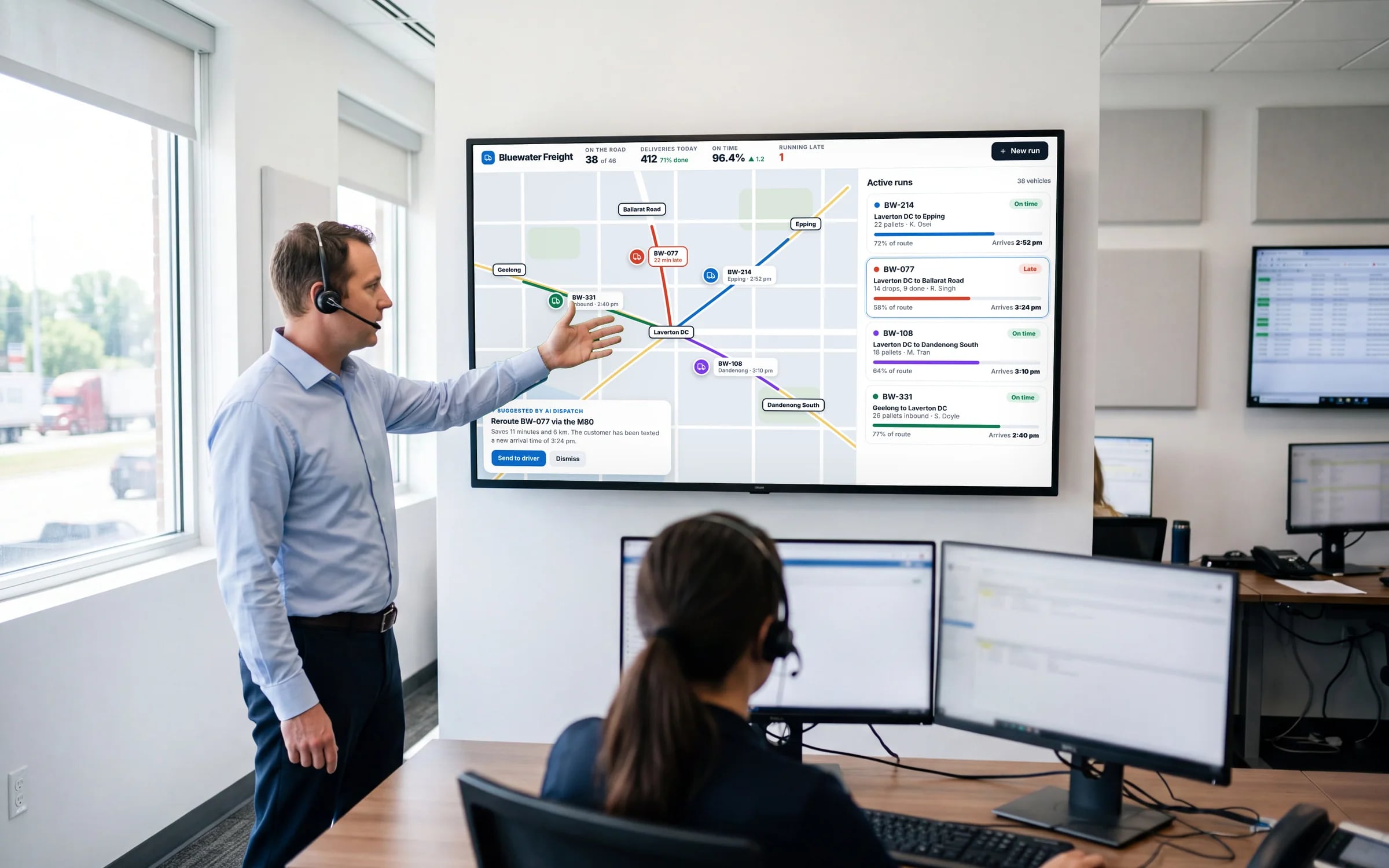
A day in your business, rebuilt. Watch it run.
The same day you have now, with the system doing the chasing. Pick any moment to stop on it.
Bookings · now
Overnight bookings are already on the board, grouped by run and vehicle size.
Illustrative. Based on how businesses like yours usually run.
Where the hours go. What we hear from almost every business like yours.
- 01Dispatch lives in one person's headWhen your dispatcher is off, the board falls apart. Nobody else can see which driver has capacity, who is running late, or which customer was promised a window.
- 02Proof of delivery arrives days laterSigned dockets come back crumpled in the cab. Disputes drag on and you can't invoice until the paperwork is found.
- 03Invoicing waits for the end of the weekSomeone re-keys every job into accounts, adds waiting time and surcharges by hand, and cash sits in the yard instead of the bank.
- 04You can't see what a lane really earnsFuel, tolls, driver hours and rework all live in different places, so pricing is still a gut feel.

What you're probably running now. And what replaces it.
Today7 separate tools
- Spreadsheets for bookings
- A whiteboard or group chat for dispatch
- A separate driver app
- Paper or photo proof of delivery
- Xero or MYOB
- Fuel cards and toll statements
- Carrier and courier portals
With your own system
One login. One record of every job, customer and dollar.
- Booking & quoting
- Dispatch board
- Driver app
- Proof of delivery
- Billing engine
- Fleet & compliance
- Customer portal
- Lane & margin reporting
★★★★★
“We were impressed with the sheer professionalism displayed by TJ and Harry.”
What we'd build for you. Pick the parts that hurt most first.
Nobody needs every module on day one. We usually start with the one costing you the most hours, ship it in weeks, and add the rest as it proves itself.
Booking & quoting
Customer bookings by portal, email or API, priced from your own rate cards and surcharge rules.
Dispatch board
Drag-and-drop runs by driver, vehicle and time window, with capacity and licence class checks.
Driver app
Runs, stop notes, photos, signatures and pre-start checks, working offline in dead zones.
Proof of delivery
Signature, photo and GPS on every drop, visible to your customer the moment it is captured.
Billing engine
Jobs become invoices automatically with waiting time, fuel levy and tolls, then sync to your accounts.
Fleet & compliance
Rego, servicing, fatigue records and driver licences tracked with reminders before they lapse.
Customer portal
Your customers book, track and download PODs and invoices without calling your office.
Lane & margin reporting
What every customer, lane and truck actually earns after fuel, tolls and hours.
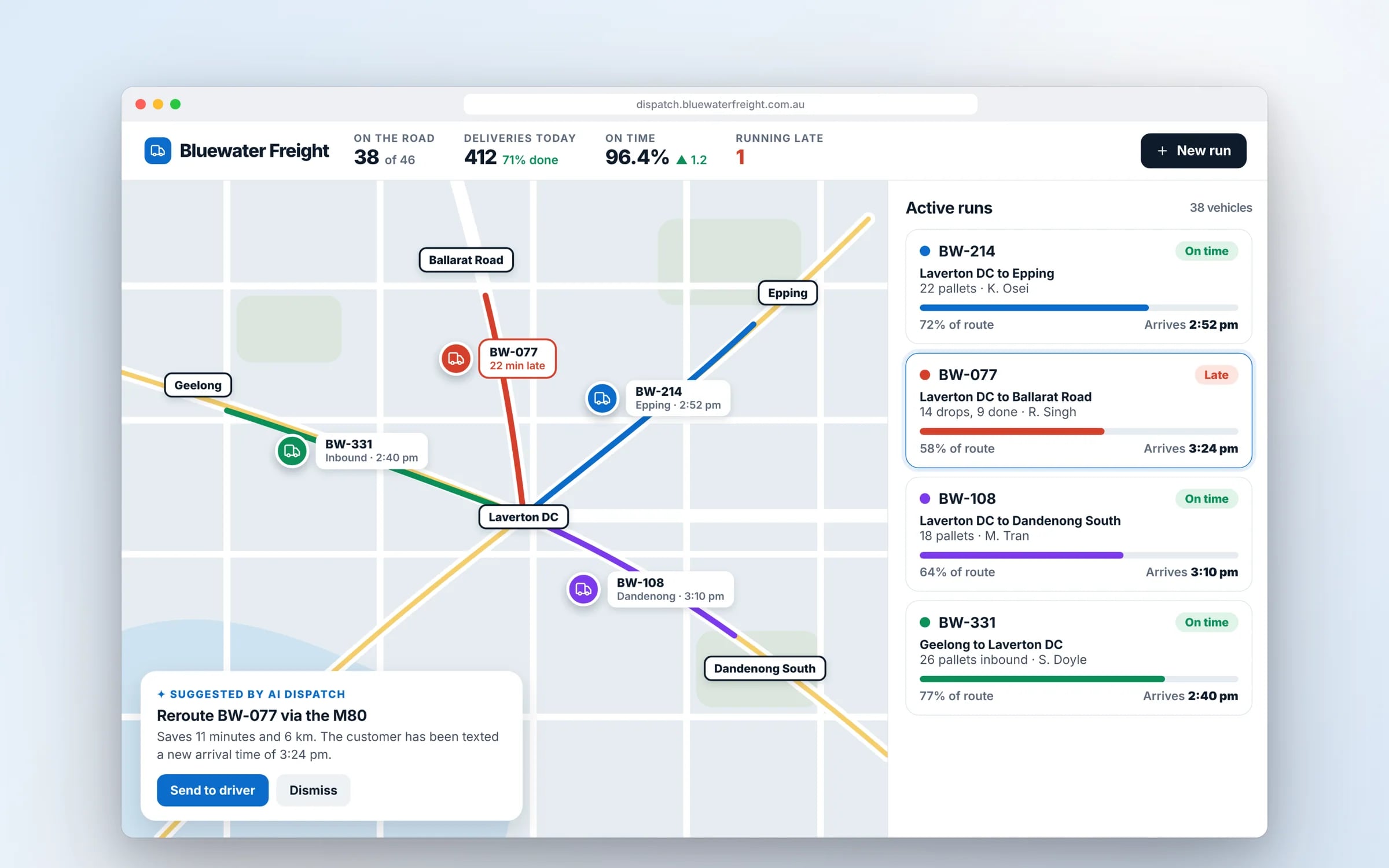
Every job on one board. From booked to invoiced.
Each delivery moves across the board as it happens: loaded, in transit, delivered. Proof of delivery lands with the job, and the invoice goes to Xero without anyone retyping it.
Five years of renting, against owning. The gap is what you keep.
The rules you work under. Built into the system, so the record keeps itself.
- Heavy Vehicle National Law: Chain of Responsibility
- Applies outside WA and the NT. The system records how each run was planned, including driver hours, vehicle and load, so scheduling decisions can be shown later.
- NHVR fatigue management and work diary requirements
- Driver hours are tracked against the fatigue limits you operate under, and the system flags runs that would breach them before they are dispatched.
- HVNL mass, dimension and loading requirements
- Each vehicle's capacity is stored and checked when jobs are added to a run, so overloaded runs are flagged at planning.
- Fair Work modern awards and record keeping
- Driver start, finish and break times are kept as employee records and passed to payroll for the award that applies.
The numbers you’d see live
- Jobs with a POD captured at the drop
- Jobs invoiced within 24 hours of delivery
- Waiting time recorded against waiting time billed
- Margin by lane after fuel, tolls and driver hours
- On-time delivery rate by customer
- Vehicle utilisation by run
How it all connects. One core, and the tools you keep.
Your accounts, payroll and the other tools that work stay where they are. The system sits in the middle, so nobody types anything twice. Hover or tap a tool to see what moves across.
Parts of your system
- Booking & quoting
- Dispatch board
- Driver app
- Proof of delivery
- Billing engine
- Fleet & compliance
- Customer portal
- Lane & margin reporting
Running
Your system
Logistics & transport
- Logins
- One
- Record of each job
- One
- Owner
- You
Your system → Xero
Agents do the reading and typing. People keep the decisions.
The agents run inside your own system, on your data and your rules. They read, match and draft. Wherever money, safety or a customer is involved, a person signs off, and every action is logged.
Booking emails into jobs
TodaySomeone in the office retypes each emailed booking into the system.
With an agentReads the email and attachments, creates the job with addresses, pallets and time window, and prices it from your rate card.
Where you come inAnything outside the rate card waits for a tick.
Late-run alerts
TodayDispatch finds out a run is late when the customer rings.
With an agentWatches GPS against the plan and drafts the customer message as soon as an ETA slips.
Where you come inDispatch sees the draft and sends or edits it.
Invoice queries
TodayAccounts digs through dockets to answer “why was I charged waiting time?”
With an agentPulls the POD, timestamps and surcharge rule for that job and writes the reply.
Where you come inCredits over your limit need sign-off.
What software does a logistics and transport business need?
A transport business needs one system that takes a booking, prices it from your rate card, puts it on a run, captures proof of delivery and turns the finished job into an invoice.
Around that sit a driver app that works offline, fleet and driver compliance records, and margin reporting by lane and customer. Hypex builds that system around how your depot runs, and you own the code and the data.
Reviewed by the Hypex team, Port Melbourne
Logistics & transport: questions owners ask.
What is the best transport management software in Australia?
The best transport management software is the one that matches how you price, dispatch and invoice, so start with your rate cards and your billing rules before you look at features. Packaged products such as CartonCloud and MachShip suit many operators and are worth trialling. A custom TMS makes sense when your surcharges, customer contracts or run planning don't fit a packaged model, when you are re-keying jobs between three tools, or when you want the system to be an asset you own. Hypex starts with a 30-minute call and a system map with a fixed price per stage, so you can compare like for like.
How do I digitise proof of delivery?
You digitise proof of delivery by giving drivers an app that captures a signature, photos, the time and the GPS location at every drop, and sends it to the job record the moment it is saved. The app should work offline in loading docks and regional dead zones, then sync when signal returns. Once the POD lands on the job, the customer can see it in a portal and the job can move straight to invoicing. Paper dockets can still be photographed and attached during the changeover, so nobody is caught without a record while drivers get used to the app.
Do my drivers need an electronic work diary?
No, an electronic work diary is optional: the NHVR accepts the written work diary, and an NHVR-approved electronic work diary is an alternative your drivers can choose to use. A work diary is generally needed when someone drives a fatigue-regulated heavy vehicle more than 100 km from their base. Your dispatch system does not have to be the work diary. It can hold each driver's planned and actual hours so runs are built inside fatigue limits, and where your EWD provider offers access to its data, it can pull that in as well.
How do I calculate a fuel levy on freight invoices?
Most operators apply the fuel levy as a percentage on top of the base freight charge, and move that percentage up or down against a published diesel price on a set schedule, such as weekly or monthly. The important part is consistency: the same rule, applied the same way, to every customer on that schedule, with the rate in force recorded on each invoice. In a custom system the levy table lives in one place, each customer's contract says which table applies, and every job picks up the right rate when it is invoiced. Nobody has to remember to change a spreadsheet.
How do I stop waiting time from going unbilled?
You stop waiting time going unbilled by recording arrival and departure times at each stop in the driver app and letting the system apply your waiting time rules automatically. If your terms allow, say, a free period before charges start, the system counts from the arrival time and adds the charge to the job without anyone working it out later. Because the times come from the app with a location attached, disputes are easier to settle. The office then reviews exceptions instead of rebuilding every job from dockets at the end of the week.
What does Chain of Responsibility mean for my dispatch software?
Under the Heavy Vehicle National Law (in force everywhere except Western Australia and the Northern Territory, which have their own rules), everyone in the chain who has influence over a heavy vehicle transport task, including schedulers, has a duty to ensure its safety so far as is reasonably practicable. For dispatch, that means the way runs are planned should not push drivers past fatigue limits, encourage speeding or overload a vehicle. Software helps by checking driver hours, licence class and vehicle capacity when a run is built, flagging delivery windows that can't be met safely, and keeping a record of what was planned. That record shows the decisions you made, and why.
Can you build a transport management system for a mid-sized freight business?
Yes. We design and build transport management systems around how your operation runs: bookings, rate cards, dispatch, a driver app with proof of delivery, billing and reporting. You own the software and the code.
Will a custom system connect to Xero and our carrier accounts?
Yes. We connect to accounting platforms like Xero and MYOB, and to carriers and couriers that publish APIs, such as Australia Post, StarTrack, Couriers Please and Aramex.
Does the driver app work without phone signal?
We build driver apps to work offline and sync when signal returns, because regional runs and loading docks often have none.
How long does it take to replace our current setup?
Most operators see a first working version in weeks, usually starting with the part that costs them most, such as dispatch or billing, and then extending from there.
You own it
The software and its source code belong to your business. No per-seat fees growing with every hire.
What owning meansFunding may help
Parts of some builds may qualify for the R&D Tax Incentive. We'll help you and your adviser work out which.
How the incentive worksKnow your numbers
Add up what your subscriptions, re-keying and workarounds cost you each year before you talk to anyone.
Open the calculatorWeighing up a packaged product?
Other industries we build for
Show us how you run it today.
Thirty minutes with the people who would build it. We'll map where the hours go and tell you honestly whether custom software is worth it for you.