Trade pricing, stock and orders in one place. Your customers order themselves at 10 pm.
For wholesalers and distributors selling to trade and business customers.
Every customer has their own price, your reps take orders by phone and text, and stock levels are a guess until someone checks. We build B2B ordering and distribution systems with your real price lists, live stock and account terms, so customers can order without you.
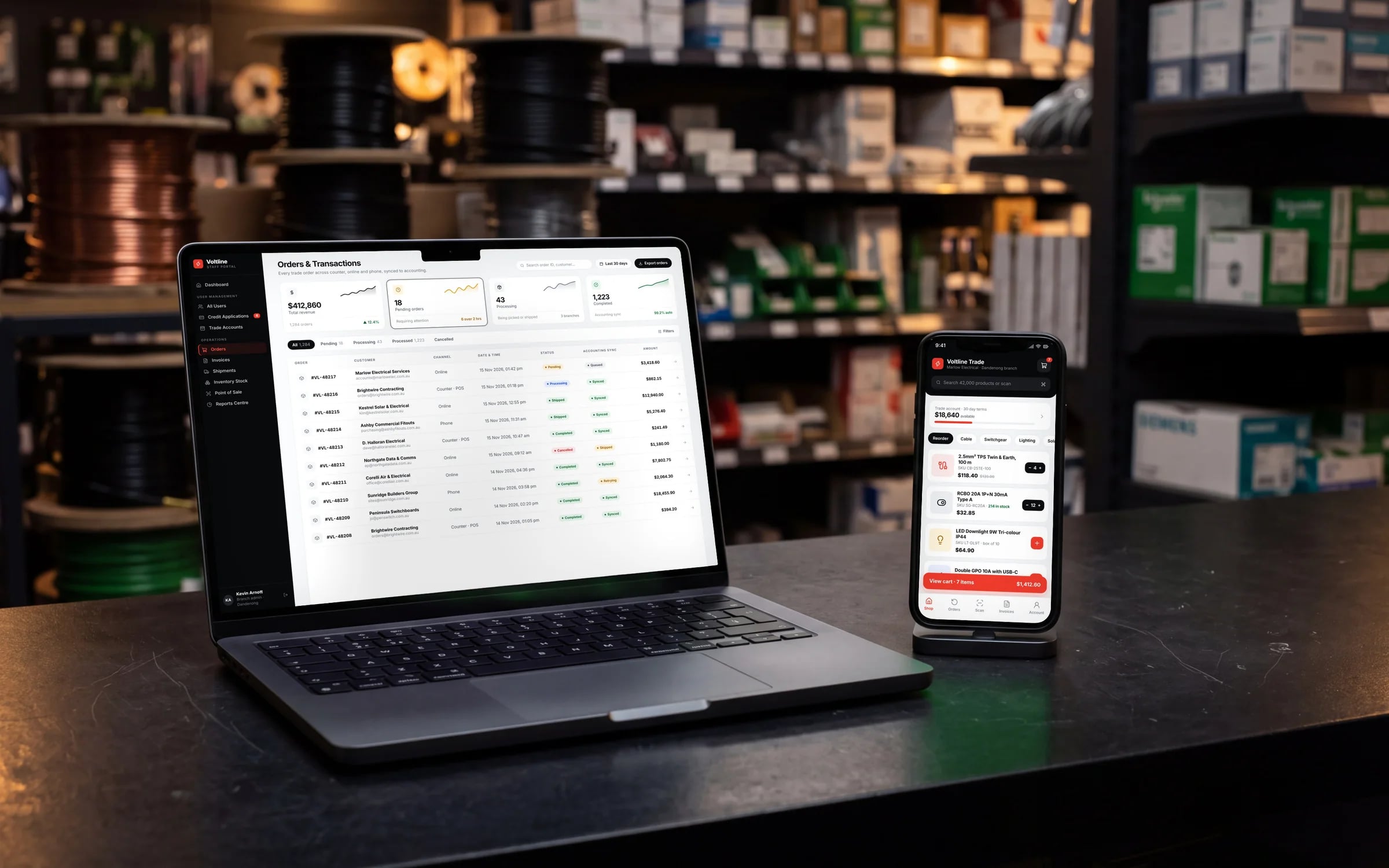
Where the hours go. What we hear from almost every business like yours.
- 01Pricing lives in someone's spreadsheetCustomer-specific pricing, contract rates and volume breaks are hard to keep straight and easy to get wrong.
- 02Your team are order takersPhones and inboxes fill with orders that customers would happily place themselves if they could see stock and their price.
- 03Stock is a surpriseBack orders are found after the sale, and purchasing runs on feel rather than real demand.

A day in your business, rebuilt. Watch it run.
The same day you have now, with the system doing the chasing. Pick any moment to stop on it.
B2B portal · now
Trade customers have placed orders overnight at their own pricing, against live stock.
Illustrative. Based on how businesses like yours usually run.

What you're probably running now. And what replaces it.
Today5 separate tools
- An accounting package with inventory
- Price lists in spreadsheets
- Orders by phone, email and text
- A basic online store
- Rep notes in a CRM or notebook
With your own system
One login. One record of every job, customer and dollar.
- B2B ordering portal
- Pricing engine
- Inventory & purchasing
- Accounts & credit
- Rep tools
What we'd build for you. Pick the parts that hurt most first.
Nobody needs every module on day one. We usually start with the one costing you the most hours, ship it in weeks, and add the rest as it proves itself.
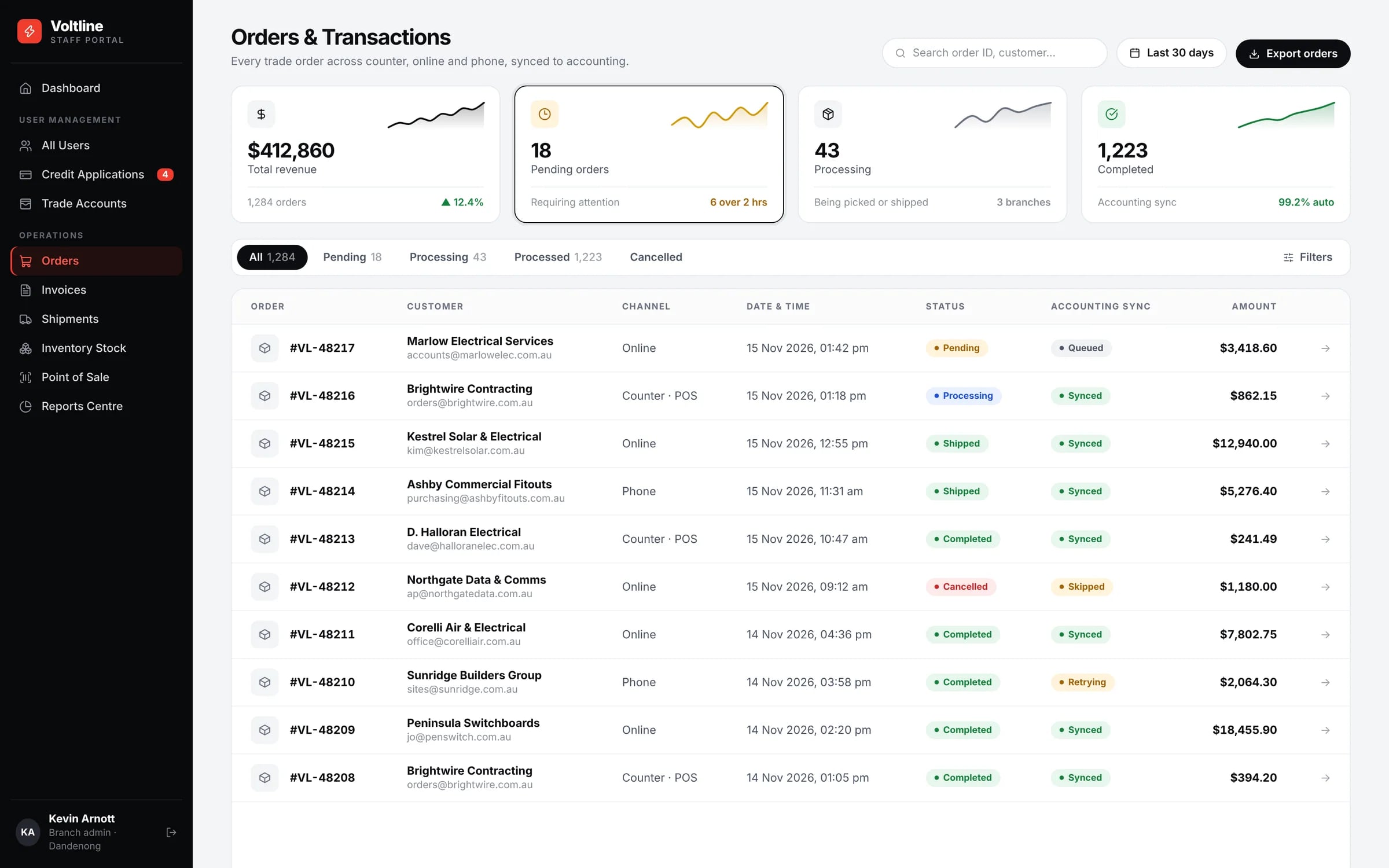
B2B ordering portal
Customers log in, see their pricing and stock, reorder in a few taps and track deliveries.
Pricing engine
Customer, contract, volume and promotional pricing from one set of rules.
Inventory & purchasing
Multi-location stock, reorder points and supplier purchase orders.
Accounts & credit
Account terms, credit limits and statements tied to every order.
Rep tools
Customer history, quoting and orders on the road from a phone.
★★★★★
“TJ helped me in creating a super creative user interface. I got the results that I wanted.”
Built by Hypex · Electrical wholesale & trade
Electrical supply marketplace
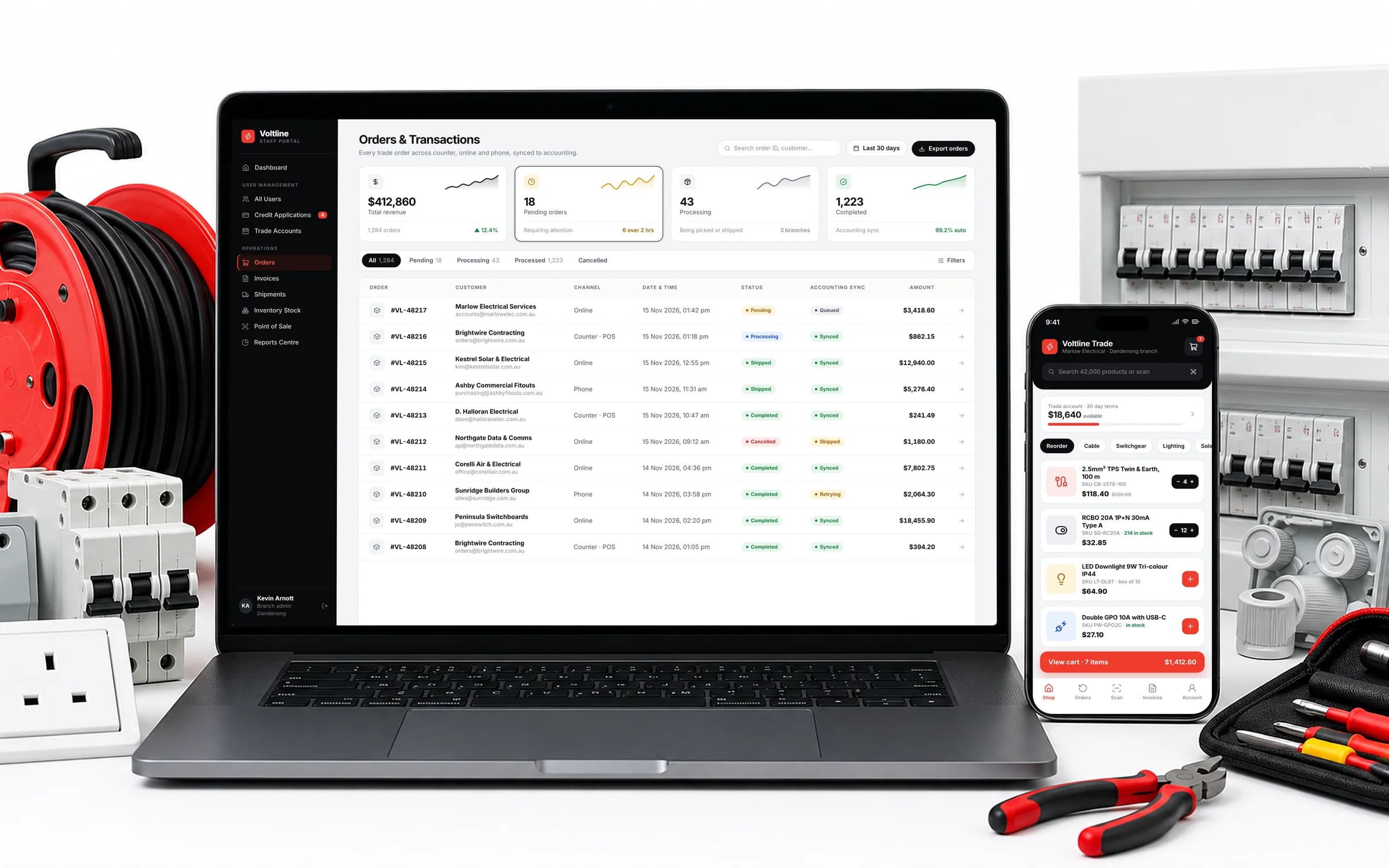
Electrical products, trade pricing, stock availability and account ordering brought into one catalogue built for contractors and wholesale customers.
- Electrical product catalogue
- Trade pricing and ordering
- Stock and account management
Three numbers that agree. Takings, the books and the bank, matched every night.
Sales from the till, the ledger and the bank feed are matched every night. Anything that doesn't reconcile is flagged for the morning with its reason beside it.
Five years of renting, against owning. The gap is what you keep.
The rules you work under. Built into the system, so the record keeps itself.
- GST and tax invoice requirements
- Invoices are generated with the details the ATO requires of a tax invoice, including the buyer's identity or ABN where the sale is $1,000 or more.
- Food Standards Code: Standard 3.2.2 recall systems (where you wholesale food)
- Batch numbers are recorded on receipt and despatch, so the system can list which customers received an affected batch.
- Privacy Act 1988 and the Australian Privacy Principles (where they apply to you)
- Customer contact and account details are held with access limited by role, and the system records who changed them.
- Fair Work modern awards and record keeping
- Warehouse and driver hours are kept as employee records and passed to payroll for the award that applies.
The numbers you’d see live
- Orders placed through the portal against phone and email
- Order lines filled complete on first despatch
- Back orders older than their expected date
- Stock below reorder point without a purchase order
- Overdue balance by trade account
- Gross margin by customer and product group
How it all connects. One core, and the tools you keep.
Your accounts, payroll and the other tools that work stay where they are. The system sits in the middle, so nobody types anything twice. Hover or tap a tool to see what moves across.
Parts of your system
- B2B ordering portal
- Pricing engine
- Inventory & purchasing
- Accounts & credit
- Rep tools
Running
Your system
Wholesale & distribution
- Logins
- One
- Record of each job
- One
- Owner
- You
Your system → Xero
Agents do the reading and typing. People keep the decisions.
The agents run inside your own system, on your data and your rules. They read, match and draft. Wherever money, safety or a customer is involved, a person signs off, and every action is logged.
Purchase orders from customers
TodayReps or office staff key PDF and emailed orders line by line.
With an agentReads the PO, maps their part numbers to yours, applies their price list and builds the order.
Where you come inPrice or stock exceptions wait for a person.
Reorder suggestions
TodayBuying runs on gut feel and a stock report printed on Monday.
With an agentDrafts purchase orders from sales velocity, lead times and what's already inbound.
Where you come inThe buyer edits and releases them.
Account follow-ups
TodayOverdue accounts get chased when someone has a spare afternoon.
With an agentSends the right reminder at the right stage and puts accounts on hold by your rules.
Where you come inHolds on key accounts need approval.
What software does a wholesale and distribution business need?
A wholesale or distribution business needs one system that holds every customer's pricing, shows live stock, takes orders from a trade portal and from reps, and invoices on account against credit terms.
Purchasing should run from real demand and reorder points, and everything should sync to your accounting package. Hypex has shipped an electrical supply marketplace and builds these systems around the way your trade customers already buy.
Reviewed by the Hypex team, Port Melbourne
Wholesale & distribution: questions owners ask.
What is the best B2B ecommerce platform for wholesalers in Australia?
The best B2B platform for a wholesaler is the one that shows each customer their own price, live stock and account terms, and passes the order straight to fulfilment and your accounts. Shopify offers B2B features, and inventory systems such as Cin7 and Unleashed include B2B stores that suit many distributors. A custom portal makes sense when your pricing rules are complex, when customers order by project, branch or job number, or when the portal needs to work with a stock or accounts setup the packaged options don't support. List your three hardest pricing cases and test every option against them.
How do I manage customer-specific pricing without spreadsheets?
You manage customer-specific pricing by moving it into a pricing engine that works from rules: a base price list, customer or group price levels, contract prices for named products, volume breaks and promotions, with a clear order of which rule wins. Every quote, portal order and rep order then reads from the same rules, so the price is the same no matter who takes the order. Changes are made once with a start and end date, and the system keeps a history, so you can see what a customer was charged and why.
How do I set reorder points for my stock?
A reorder point is usually set as your average daily sales of an item multiplied by the supplier's lead time in days, plus a safety stock buffer for variation in demand and delivery. The numbers should come from your real sales history, and they should be reviewed as demand changes rather than set once and forgotten. A system can recalculate reorder points from recent sales, flag items that have gone below them, and draft purchase orders grouped by supplier for someone to approve. Seasonal lines and new products still need a person's judgement.
How can my reps take orders on the road?
Reps take orders on the road best from a phone or tablet app that shows each customer's pricing, stock, order history and account status, and sends the order straight into the same system as your portal and office orders. Seeing what a customer usually buys helps the rep suggest the reorder before the call ends. The app should keep working without signal and sync later, and it should warn the rep if an account is on hold or over its limit. That stops the office re-keying orders from notes and text messages.
How do I enforce credit limits on trade accounts?
You enforce credit limits by having the ordering system check each account's balance, overdue amount and limit before an order is released, and hold any order that would break the rules you set. Holds go to the person who manages credit, who can approve, call the customer or ask for payment. The customer can see their balance and pay outstanding invoices in the portal, which often clears the hold without a call. Balances should come from your accounting system so the check is against real figures.
How should a distributor handle back orders?
A distributor should handle back orders by recording the unfilled lines against the original order, telling the customer straight away with an expected date, and allocating incoming stock to them in the order you choose when it arrives. The customer should be able to cancel or change a back order from the portal. Your system can show which purchase orders will fill which back orders, so purchasing knows what is urgent. Back orders that sit too long should appear on a report for someone to act on.
Can you build a B2B ordering portal with customer-specific pricing?
Yes. We build trade portals where each customer sees their own prices, stock and account terms, and can order and pay without calling you.
Will it work with our existing accounting and stock?
We connect to platforms like Xero and MYOB, or replace the stock side entirely if your current tools can't keep up.
You own it
The software and its source code belong to your business. No per-seat fees growing with every hire.
What owning meansFunding may help
Parts of some builds may qualify for the R&D Tax Incentive. We'll help you and your adviser work out which.
How the incentive worksKnow your numbers
Add up what your subscriptions, re-keying and workarounds cost you each year before you talk to anyone.
Open the calculatorWeighing up a packaged product?
Other industries we build for
Show us how you run it today.
Thirty minutes with the people who would build it. We'll map where the hours go and tell you honestly whether custom software is worth it for you.